Loading precomputed statistics...
Total Packets
Each packet is usually a single crosschain transaction, rarely a bundle of them
LayerZero Picks Verifiers
Incoming packets on routes where LayerZero's admin can change which DVNs are enough to deliver a packet: the route inherits the default library, the whole default ULN config, or the default required DVNs
Any LayerZero Default
Incoming packets on routes that inherit at least one validation setting from LayerZero, including confirmations or optional DVNs. Compare with All-Default, which requires inheriting everything
All-Default
Incoming packets validated by inheriting the standard LayerZero validation library and settings.
Default Library
Incoming packets falling back to the default smart contract (library), not packets that explicitly set the same library
Tracked Library
Incoming packets validated by a library of which we decode the validation settings (config)
Distinct DVN Sets
Unique validation setups (required DVNs plus any optional quorum). Every chain runs its own DVN contracts, deployed, keyed and administered separately, so the same operators on two chains count as two sets
Chains indexed
Configured destination chains indexed by the current HyperIndex v3 setup
Chains seen
Unique source endpoint IDs of incoming packets, including lzRead response channels
Packet
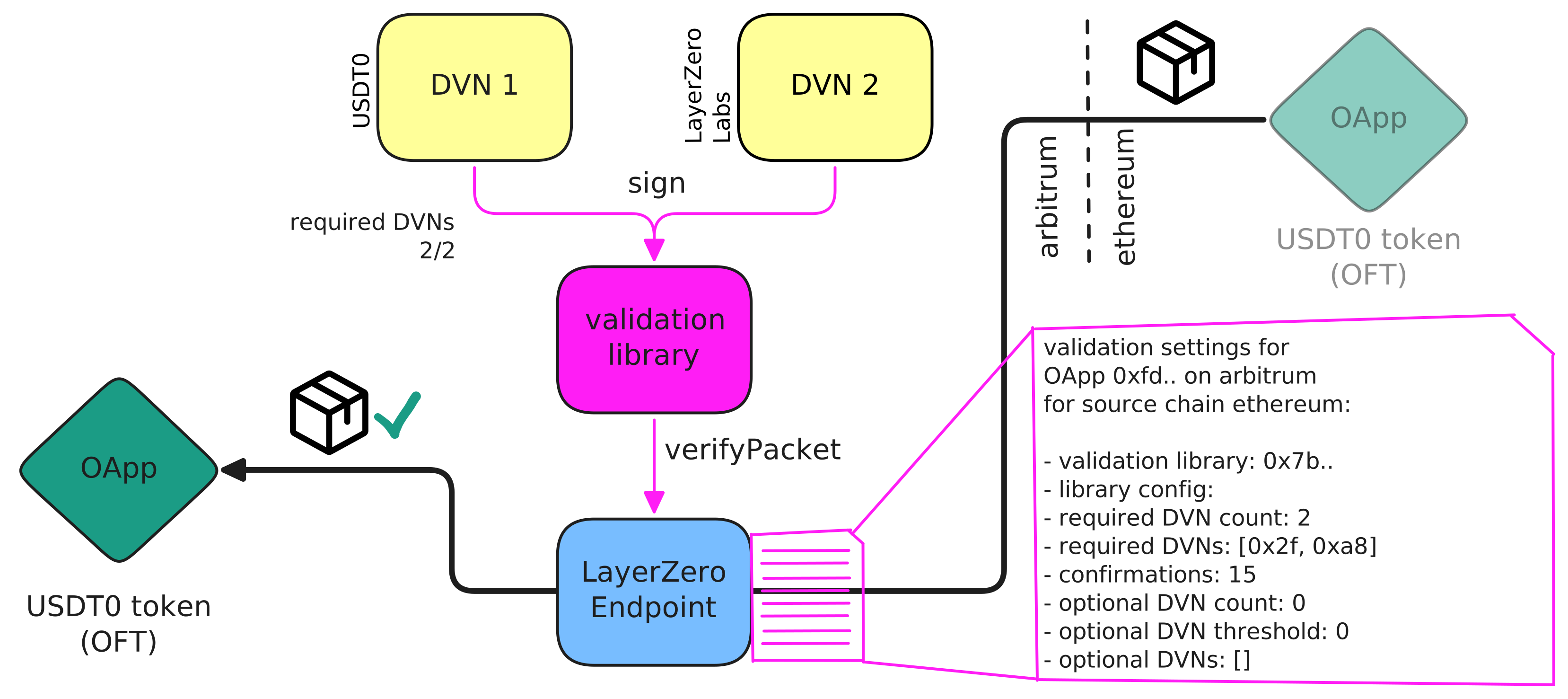
Packets contain a message payload, source EID and destination EID, source OApp address and destination OApp address
DVN
DVN is largely a misnomer, implying multiple validators where in reality there is always a single smart contract and often validation of a single entity's signature
OApp
Most OApps implement token functions. There is no restriction on what an OApp can be, it just needs to include the standard LayerZero messaging interface
OFT
OFTs are the most widely used type of OApp. OFT can refer to a single token on a single chain or the abstracted set of all tokens of the same type across chains
EID
EIDs are needed because some blockchains use the same chain IDs (e.g. Aptos and Ethereum)
Validation Library
The library can be thought of like a panel of switches, allowing for fine-grained control over validation settings
ULN config
ULN, ReceiveUln302 and library are just other words for this specialized smart contract
Who Controls Verification?
Fraction of packets by who can change the settings that validated them
"LayerZero" here means the owner of the EndpointV2 and ReceiveUln302 contracts on the destination chain, who sets the default library and default ULN config. Owner-controlled is not the same as safe: the OApp owner can change its own settings just as unilaterally.
DVN Set Threshold
Fraction of packets by the number of DVNs that must validate incoming packets. Optional-only quorum 2 of 3 counts as 2; required plus optional quorum x + 2 counts as x + 2.
Top DVN Sets
Most common DVN sets by packet count (top 20), grouped by operator name
Packet Volume Over Time
Hourly packet count across entire time range
Configuration Changes Over Time
Receive library and ULN config changes, by LayerZero (defaults) and by OApp owners
Packets by Destination Chain
Destination chain packet distribution
Packets by Source Chain
Source chain packet distribution
Fragility of Scale
Since you are still here, i invite you to contemplate our motivation for building distributed systems and my motivation for building this website. Some of these systems aim to disintermediate, remove single points of failure, and enhance resilience through decentralization. LayerZero does the opposite by distributing their points of failure. Each added node or edge makes the network more fragile. The protocol fundamentally cannot scale without compromising its security.
LayerZero is by far not the only nor the worst offender among the interop protocols. It is built transparently enough to allow for a monitor like this one that hints at the magnitude of risk. Many competing interop protocols do not provide this onchain transparency. But the existence of more robust, more transparent and more scalable solutions shows that interop can actually be built, and scale, well.
Scroll further to get an intuition for LayerZero's Fragility of Scale.

Fragility of Scale, Measured
An OApp on N chains is a web of up to N×(N−1) inbound routes, each with its own library and DVN settings. A forged packet only has to pass the weakest one. Webs are OApps linked by configured or observed peers, counting only webs that received packets in the last 30 days (independent of the time range above).
Routes per web
Each dot is one web. Dashed line: N×(N−1), every chain talking to every other. Colour: DVNs needed on the weakest open route.
Busiest webs
By packets received in the last 30 days. Operators counts DVN organisations; DVN contracts counts the separately deployed verifier contracts they run on each chain of the web. Routes are open inbound routes. Open a web in the explorer to see every route.